Academic Work
I enjoyed my time in academia. Here is some memorable academic work from that era.
My Degrees
- M.Sc., Computer Science, Rutgers University, New Brunswick
- B.Sc., Computer Engineering, University of California, Irvine
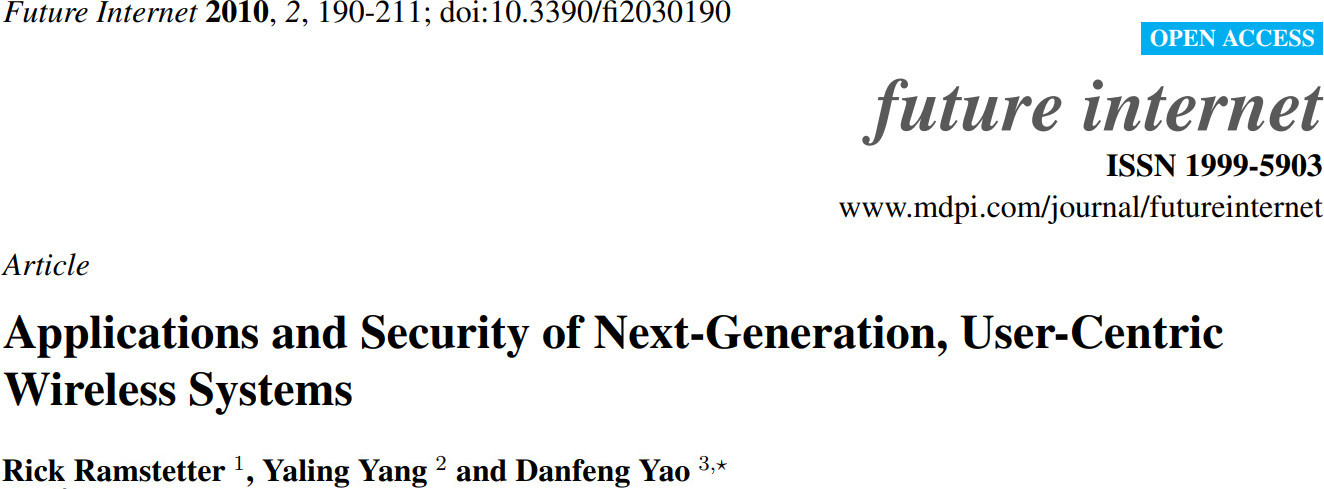
Applications and Security of Next-Generation, User-Centric Wireless Systems
Publication in an open-access journal, MDPI’s future internet. Date: 2010/07/28
Abstract: Pervasive wireless systems have significantly improved end-users’ quality of life. As manufacturing costs decrease, communications bandwidth increases, and contextual information is made more readily available, the role of next generation wireless systems in facilitating users’ daily activities will grow. Unique security and privacy issues exist in these wireless, context-aware, often decentralized systems. For example, the pervasive nature of such systems allows adversaries to launch stealthy attacks against them. In this review paper, we survey several emergent personal wireless systems and their applications…
Title content of Applications and Security of Next-Generation, User-Centric Wireless Systems
Stamping and Extracting Bump Maps
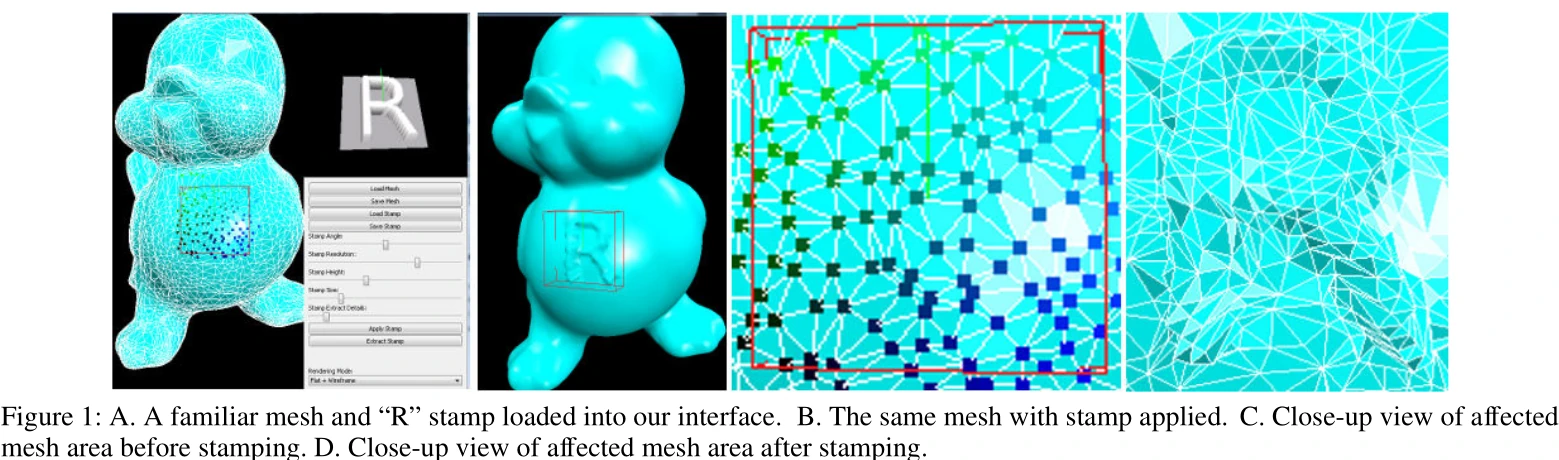
Rutgers M.Sc. coursework in which my lab partner and I implemented a “copy and paste” interface for editing graphics meshes. Date: 2009/05/05
Abstract: We have implemented a “copy and paste” styled interface for mesh editing. This interface allows the user to both a) input a grayscale bump-mapping image and “stamp” this image onto parts of a loaded mesh, and b) extract grayscale bump-mapping images from a given mesh. For stamp application, mesh faces are upsampled via Sqrt-3 subdivision for high gradient areas of the bump-mapping image. Relevant vertices are then moved along their smoothed-surface normal to achieve their new, post-stamping position. For extraction, relevant areas of the mesh are interpolated via Moving Least Squares in order to meet the user’s stamp size and resolution requirements.
Coursework: Stamping and Extracting Bump Maps
Modifying Bochs IA32 emulator to simulate a 2-level cache
Rutgers M.Sc. coursework in which my lab partners and I modified the Bochs IA32 emulator to contain a one-off 2-level cache simulator. Date: 2010/12/03
Assignment: …Your job is to show, for each of these benchmarks, the impact of cache parameters such as total size, line size, associativity, and miss latencies on cache miss rates and average memory access times…

Coursework: a 2-level cache simulator in Bochs IA32 emulator
Simulation and evaluation of Bezier-spline Trajectory Based Routing
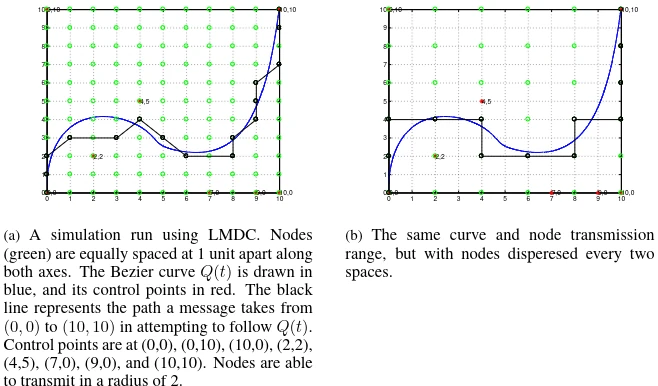
Rutgers M.Sc. coursework in which I simulated and evaluated a trajectory-based routing protocol in Matlab. Date: 2010/04/19
⚠️ This draft copy has typos.
Abstract: In dense sensor networks, Trajectory Based Routing (TBR) allows a source node to encode in some packet’s header a mathematical (e.g. polynomial) curve defining that packet’s route. Intermediary nodes make a best-effort to route the packet along this curve. Bezier curves, used widely in computer graphics, allow message trajectories to be described by complex and non-invertable curves. In this work, I implement in Matlab a generalized simulator for TBR protocols in dense sensor networks. Atop that simulator, I implement multiple variations of the same Bezier-spline routing protocol. By using a Bezier-spline representation of trajectories…
Coursework: Simulation and evaluation of Bezier-spline Trajectory Based Routing
IPv4 will remain sufficient in North America for the next 30 years
Rutgers M.Sc. coursework in which I argued that IPv4 will suffice in North America until the year 2039. Date: 2008/11/28
⚠️ This draft copy has typos.
Abstract: …These extensions to IPv4’s lifetime have led many to question the urgency of deploying IPv6. While recognizing that IPv4’s lifetime is indeed finite, I argue that such questioning is warranted, and that IPv4 will be sufficient in North America for at least the next 30 years….
Position paper: IPv4 sufficiency